Des signaux dispersés
Messages internes, réactions publiques, articles, contenus vidéo et informations de contexte : une succession de slides rend difficile la représentation d’un environnement crédible.
Plateforme de simulation de crise multicanale
Crisis Input vous aide à préparer un scénario, organiser une session d’exercice, diffuser des signaux dans des canaux simulés et revenir sur le déroulé de l’exercice.
Pour les entreprises, cabinets et formateurs. Crisis Input est un environnement d’exercice, pas un outil de diffusion réelle.
Le point de départ
Une crise se construit à partir de signaux, d’informations incomplètes, de réactions internes et de prises de parole visibles. L’exercice a besoin d’un contexte à interpréter — puis d’un déroulé à analyser.
Messages internes, réactions publiques, articles, contenus vidéo et informations de contexte : une succession de slides rend difficile la représentation d’un environnement crédible.
Un exercice a besoin d’une chronologie. Certains événements se préparent ; d’autres doivent pouvoir être déclenchés ou ajustés au bon moment.
Sans trace structurée des événements, décisions et productions, le retour d’expérience repose trop facilement sur les souvenirs de chacun.
Le modèle Crisis Input
Crisis Input part d’un scénario et le transforme en session d’exercice. Les personnes, les canaux, les contenus et la chronologie sont préparés avant de piloter les événements pendant la session.
La base réutilisable de votre exercice.
Participants, canaux, ressources et contenus.
Une instance isolée pour un exercice donné.
Chronologie et événements à déclencher.
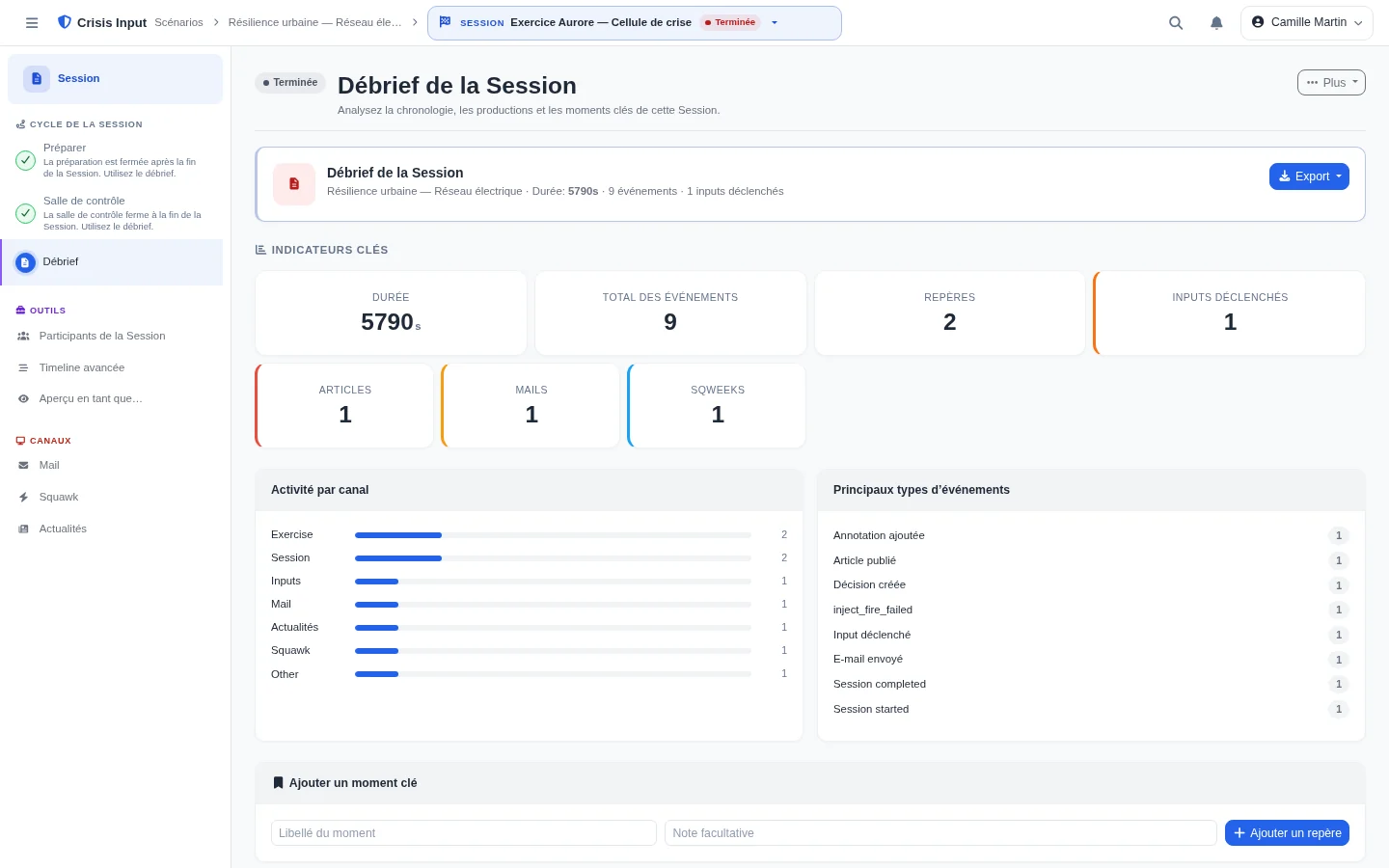
Retour sur le déroulé, évaluations et exports.
La plateforme
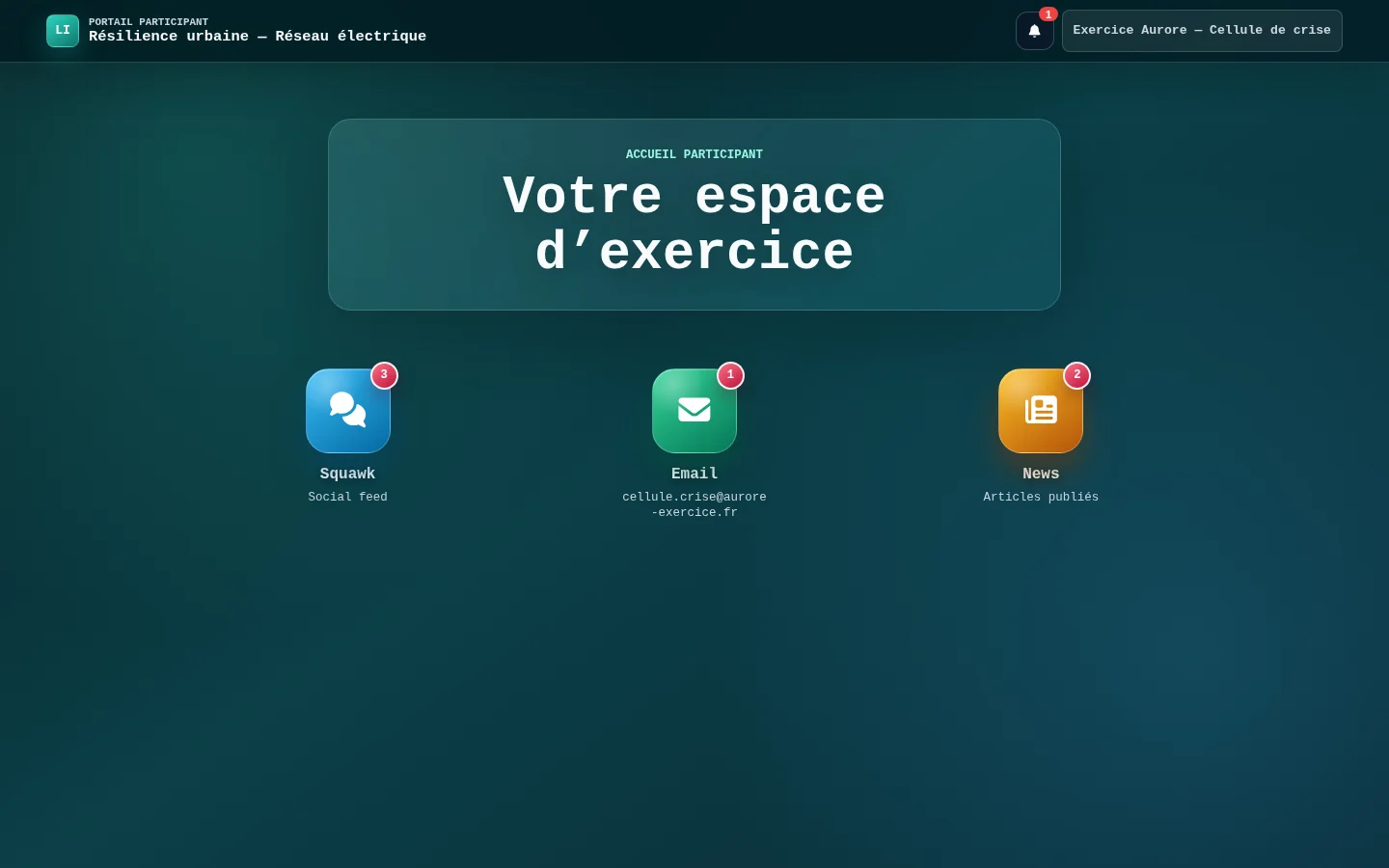
Explorez les canaux simulés : chaque tuile ouvre un aperçu du parcours participant et de la place du canal dans votre exercice.
Des images circulent déjà. Qui confirme l’information ?
↩ 12 ♡ 48Suivi de situation en cours.
↩ 8 ♡ 31Canal simulé
Faites circuler publications, hashtags, réponses et réactions sur un réseau social fictif. Les participants interprètent les signaux publics sans utiliser une plateforme réelle.
Les informations se précisent au cours de la session.
Canal simulé
Donnez à votre exercice une couverture presse fictive : articles, événements en direct, commentaires et réactions prennent place dans le tempo que vous préparez.
Point de situation
16:42
Canal simulé
Ajoutez une dimension audiovisuelle à la mise en situation avec des chaînes, séquences vidéo et bandeaux d’information simulés.
Validation de la prise de parole
14:32Proposition de message interne
14:16Situation sur le terrain
13:58Canal simulé
Simulez les échanges internes de l’exercice sans envoyer de vrais e-mails externes. Les messages, boîtes et groupes restent dans le périmètre de la session.
Les éléments de contexte de l’organisation fictive.
Canal simulé
Donnez du contexte à l’organisation fictive de l’exercice : structure, contenus institutionnels, partenaires, questions fréquentes et informations de référence.
Cette page est une simulation contrôlée pour un exercice de crise.
Canal optionnel
Illustrez un cas cyber précis dans un environnement fictif et contrôlé. Ce canal sert la narration de l’exercice ; il ne reproduit ni ne déclenche une attaque réelle.
Au-delà des canaux, une même plateforme relie aussi :
Ce que cela change
Donnez à vos équipes un cadre concret pour interpréter des informations, décider ensemble et revenir sur les faits.
Recevoir une présentationLes participants se confrontent à des signaux et canaux mis en scène pour l’exercice.
Une chronologie préparée donne un cadre à l’animation tout en laissant l’organisateur piloter le déroulé.
Un même scénario peut servir de base à plusieurs sessions distinctes.
Chronologie, évaluations et exports disponibles aident à organiser un retour d’expérience sur ce qui s’est produit.
Cas d’usage
Le scénario et les canaux sont configurés selon la situation que vous souhaitez faire travailler.
Faites émerger une crise cyber au travers des canaux utiles : informations de contexte, messagerie interne, contenus média, réseau social fictif ou site ransomware simulé.
Mettez votre équipe face à une situation qui évolue : informations internes, réactions de parties prenantes, contenus publics simulés et décisions à organiser.
Simulez la circulation d’informations, les réactions sur un réseau social fictif, l’exposition presse et les contenus à interpréter ou préparer.
Préparez un scénario, adaptez les contenus à une mission et créez une session distincte pour l’exercice concerné.
Fonctionnement
Définissez le scénario, les objectifs, les participants et les canaux.
Organisez contenus, rôles, équipes, ressources et éléments de chronologie.
Créez une session séparée du scénario de base et vérifiez les éléments nécessaires.
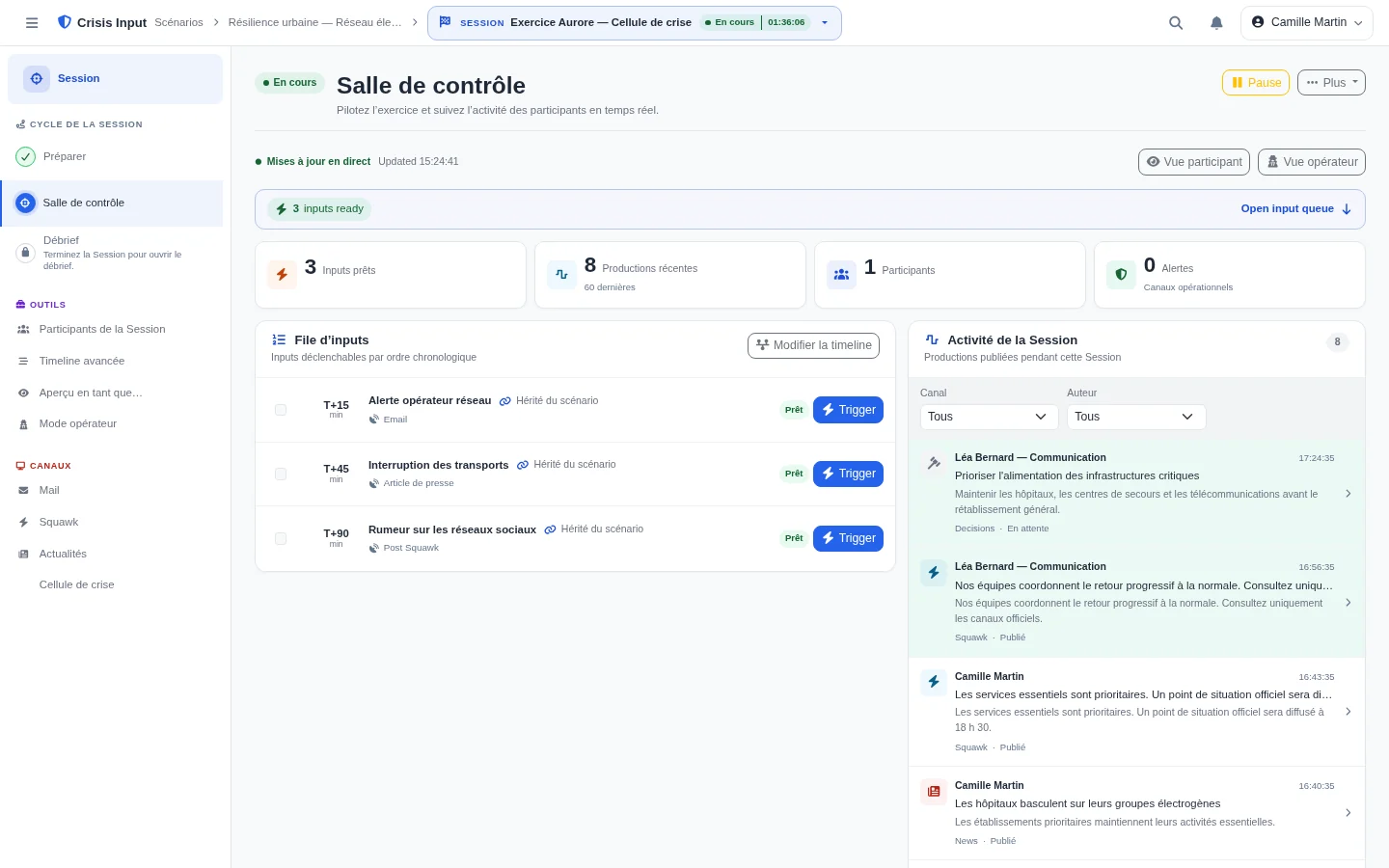
Lancez, suivez l’état de la session, déclenchez les contenus prévus et ajustez l’animation.
Revenez sur la chronologie, les productions participantes et les évaluations disponibles.
Deux contextes, une même plateforme
Direction de crise, sécurité, continuité, communication, opérations, RH ou direction générale : donnez un cadre commun à votre mise en situation et à son retour d’expérience.
Échanger sur un exercice interneConcevez des exercices plus incarnés pour vos clients, adaptez les contenus à leur contexte et pilotez les canaux de simulation depuis une même plateforme.
Découvrir l’approche pour une mission clientUn cadre clair
Crisis Input sert à préparer, faire vivre et débriefer un exercice dans un environnement dédié.
Chaque session possède son propre périmètre de participants, d’événements, d’activité et de débrief.
Les suggestions générées ne remplacent pas la validation de l’organisateur.
Chronologies, grilles d’évaluation et exports sont proposés selon le module concerné.
Lorsqu’une démonstration publique est proposée, elle repose sur un accès dédié et contrôlé.
La plateforme
Crisis Input sert à préparer, faire vivre et débriefer un exercice dans un environnement dédié.
FAQ
Non. Crisis Input est une plateforme de simulation et d’entraînement. Elle sert à préparer, faire vivre et débriefer un exercice ; elle ne remplace pas un dispositif opérationnel de gestion d’incident.
La plateforme peut structurer différents types de situations, par exemple cyber, réputationnelle, opérationnelle, RH, produit ou gouvernance. Le scénario et les canaux activés dépendent de l’exercice que vous souhaitez préparer.
Non. La cybercrise est un cas d’usage fort, notamment grâce au site ransomware simulé, mais Crisis Input permet aussi de travailler d’autres situations de crise.
Oui. Un scénario peut servir de base à plusieurs sessions distinctes. Chaque session dispose de son propre périmètre de participants, d’événements, d’activité et de débrief.
Non. Les canaux sont activés selon les besoins du scénario. Vous pouvez préparer uniquement les surfaces qui servent la mise en situation.
Non. Les fonctions IA dépendent d’un fournisseur configuré et viennent en appui de la préparation. Les contenus générés doivent rester revus et validés par un humain.
Un aperçu public en lecture seule peut être proposé lorsqu’une démonstration maintenue est disponible. Sinon, décrivez-nous votre contexte : nous pourrons vous présenter les parcours les plus pertinents pour votre exercice.
Crisis Input fournit la plateforme de simulation. Les modalités d’accompagnement, de conception de scénario ou d’animation sont à confirmer selon l’offre proposée.
Crisis Input dispose d’une API REST pour faciliter son intégration à votre environnement. Les connecteurs et automatisations sont étudiés avec vous en fonction de vos outils, de vos contraintes de sécurité et des besoins de votre projet.
Prochaine étape
Décrivez-nous votre contexte, votre public et le type d’exercice que vous souhaitez préparer. Nous pourrons vous présenter les parcours de Crisis Input les plus pertinents.